

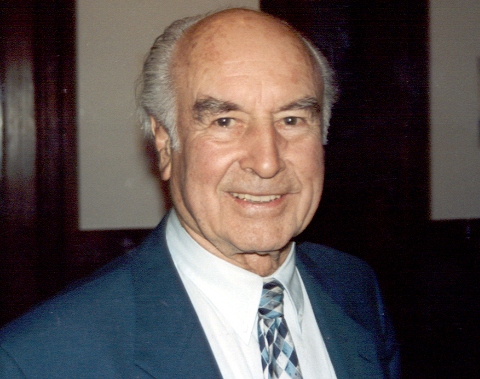
Dr. Hofmann, date unknown, with a chemical model of LSD.
This is a composite of both articles from Wikipedia and NYTimes.
Albert Hofmann, the mystical Swiss chemist who gave the world LSD, the most powerful psychotropic substance known, died Tuesday at his hilltop home near Basel, Switzerland. He was 102.
The cause was a heart attack, said Rick Doblin, founder and president of the Multidisciplinary Association for Psychedelic Studies, a California-based group that in 2005 republished Dr. Hofmann’s 1979 book “LSD: My Problem Child.”
Hofmann joined the pharmaceutical-chemical department of Sandoz Laboratories (now Novartis), located in Basel as a co-worker with professor Arthur Stoll, founder and director of the pharmaceutical department. He began studying the medicinal plant squill and the fungus ergot as part of a program to purify and synthesize active constituents for use as pharmaceuticals where his main contribution was to elucidate the chemical structure of the common nucleus of Scilla glycosides(an active principal of Mediterranean Squill). While researching lysergic acid derivatives, Hofmann first synthesized LSD-25 in 1938, the main intention of the synthesis however was to obtain a respiratory and circulatory stimulant (an analeptic). It was set aside for five years, until April 16, 1943, when Hofmann decided to take another look at it. While re-synthesizing LSD, he accidentally absorbed a small quantity through his fingertips.
He then took LSD hundreds of times, but regarded it as a powerful and potentially dangerous psychotropic drug that demanded respect. More important to him than the pleasures of the psychedelic experience was the drug’s value as a revelatory aid for contemplating and understanding what he saw as humanity’s oneness with nature. That perception, of union, which came to Dr. Hofmann as almost a religious epiphany while still a child, directed much of his personal and professional life.
Dr. Hofmann was born in Baden, a spa town in northern Switzerland, on Jan. 11, 1906, the eldest of four children. His father, who had no higher education, was a toolmaker in a local factory, and the family lived in a rented apartment. But Dr. Hofmann spent much of his childhood outdoors.
He would wander the hills above the town and play around the ruins of a Hapsburg castle, the Stein. “It was a real paradise up there,” he said in an interview in 2006. “We had no money, but I had a wonderful childhood.”
It was during one of his ambles that he had his epiphany.
“It happened on a May morning — I have forgotten the year — but I can still point to the exact spot where it occurred, on a forest path on Martinsberg above Baden,” he wrote in “LSD: My Problem Child.” “As I strolled through the freshly greened woods filled with bird song and lit up by the morning sun, all at once everything appeared in an uncommonly clear light.
“It shone with the most beautiful radiance, speaking to the heart, as though it wanted to encompass me in its majesty. I was filled with an indescribable sensation of joy, oneness and blissful security.”
Though Dr. Hofmann’s father was a Roman Catholic and his mother a Protestant, Dr. Hofmann, from an early age, felt that organized religion missed the point. When he was 7 or 8, he recalled, he spoke to a friend about whether Jesus was divine. “I said that I didn’t believe, but that there must be a God because there is the world and someone made the world,” he said. “I had this very deep connection with nature.”
Dr. Hofmann went on to study chemistry at Zurich University because, he said, he wanted to explore the natural world at the level where energy and elements combine to create life. He earned his Ph.D. there in 1929, when he was just 23. He then took a job with Sandoz Laboratories in Basel, attracted by a program there that sought to synthesize pharmacological compounds from medicinally important plants.
It was during his work on the ergot fungus, which grows in rye kernels, that he stumbled on LSD, accidentally ingesting a trace of the compound one Friday afternoon in April 1943. Soon he experienced an altered state of consciousness similar to the one he had experienced as a child.
On the following Monday, he deliberately swallowed a dose of LSD and rode his bicycle home as the effects of the drug overwhelmed him. That day, April 19, later became memorialized by LSD enthusiasts as “bicycle day.”

Further research
| “ | I think that in human evolution it has never been as necessary to have this substance LSD. It is just a tool to turn us into what we are supposed to be. | ” |
| —Albert Hofmann, | ||
Hofmann became director of the natural products department at Sandoz and went on studying hallucinogenic substances found in Mexican mushrooms and other plants used by the aboriginal people. This led to the synthesis of psilocybin, the active agent of many "magic mushrooms." Hofmann also became interested in the seeds of the Mexican morning glory species Rivea corymbosa, the seeds of which are called Ololiuhqui by the natives. He was surprised to find the active compound of Ololiuhqui, ergine (lysergic acid amide), to be closely related to LSD.
In 1962, he and his wife Anita traveled to southern Mexico to search for the plant "Ska Maria Pastora" (Leaves of Mary the Shepherdess), later known as Salvia divinorum. He was able to obtain samples of this plant but never succeeded in identifying its active compound which has since been identified as the diterpenoid Salvinorin A.

In 1963, Hofmann attended the annual convention of the World Academy of Arts and Sciences (WAAS) in Stockholm.
Hofmann called LSD "medicine for the soul" and was frustrated by the worldwide prohibition that has pushed it underground. "It was used very successfully for 10 years in psychoanalysis," he said, adding that the drug was hijacked by the youth movement of the 1960s and then unfairly demonized by the establishment that the movement opposed. He conceded that LSD can be dangerous in the wrong hands.
His Work Continues
In December 2007, Swiss medical authorities permitted a psychotherapist to perform psychotherapeutical experiments with patients who suffer from terminal stage cancer and other deadly diseases. Although not yet started, these experiments will represent the first study of the therapeutic effects of LSD on humans in 35 years, as other studies have focused on the drug's effects on consciousness and body. Hofmann supported the study, and continued to believe in the therapeutic benefits of LSD.
Hofmann was due to speak at the World Psychedelic Forum from March 21 to March 24, 2008 but was forced to pull out due to poor health.
Dr. Hofmann’s work produced other important drugs, including methergine, used to treat postpartum hemorrhaging, the leading cause of death from childbirth. But it was LSD that shaped both his career and his spiritual quest.“Through my LSD experience and my new picture of reality, I became aware of the wonder of creation, the magnificence of nature and of the animal and plant kingdom,” Dr. Hofmann told the psychiatrist Stanislav Grof during an interview in 1984. “I became very sensitive to what will happen to all this and all of us.”
Dr. Hofmann became an impassioned advocate for the environment and argued that LSD, besides being a valuable tool for psychiatry, could be used to awaken a deeper awareness of mankind’s place in nature and help curb society’s ultimately self-destructive degradation of the natural world.
But he was also disturbed by the cavalier use of LSD as a drug for entertainment, arguing that it should be treated in the way that primitive societies treat psychoactive sacred plants, which are ingested with care and spiritual intent.
After his discovery of LSD’s properties, Dr. Hofmann spent years researching sacred plants. With his friend R. Gordon Wasson, he participated in psychedelic rituals with Mazatec shamans in southern Mexico. He succeeded in synthesizing the active compounds in the Psilocybe mexicana mushroom, which he named psilocybin and psilocin. He also isolated the active compound in morning glory seeds, which the Mazatec also used as an intoxicant, and found that its chemical structure was close to that of LSD.
During the psychedelic era, Dr. Hofmann struck up friendships with such outsize personalities as Timothy Leary, Allen Ginsberg and Aldous Huxley, who, nearing death in 1963, asked his wife for an injection of LSD to help him through the final painful throes of throat cancer.
Yet despite his involvement with psychoactive compounds, Dr. Hofmann remained moored in his Swiss chemist identity. He stayed with Sandoz as head of the research department for natural medicines until his retirement in 1971. He wrote more than 100 scientific articles and was the author or co-author of a number of books
He and his wife, Anita, who died recently, reared four children in Basel. A son died of alcoholism at 53. Survivors include several grandchildren and great-grandchildren.
Though Dr. Hofmann called LSD “medicine for the soul,” by 2006 his hallucinogenic days were long behind him, he said in the interview that year.
“I know LSD; I don’t need to take it anymore,” he said, adding. “Maybe when I die, like Aldous Huxley.”
But he said LSD had not affected his understanding of death. In death, he said, “I go back to where I came from, to where I was before I was born, that’s all.”
